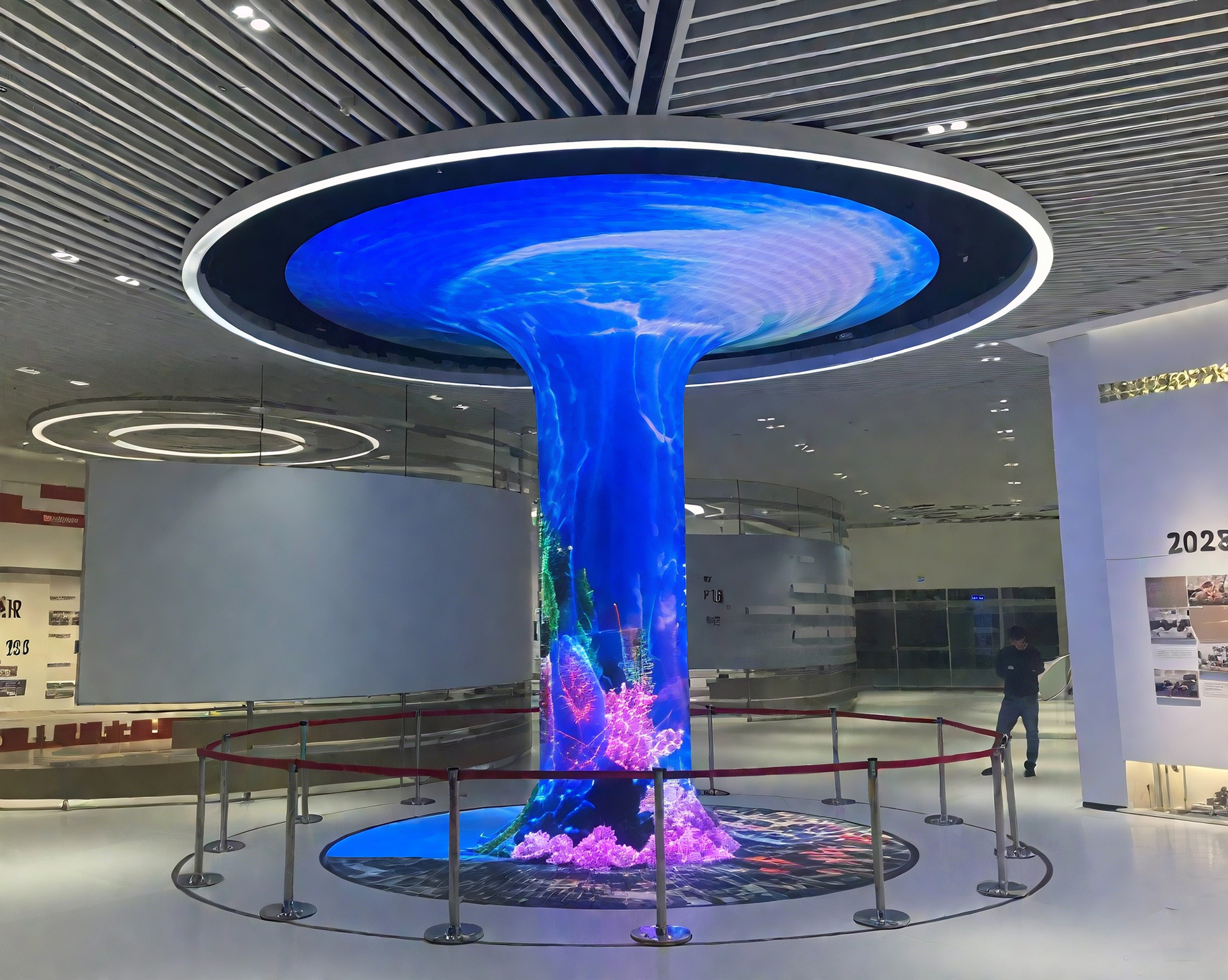
indoorled display screens are no longer exclusive to conference rooms and exhibition halls. Shopping malls, live streaming rooms, and government halls all rely on this "visual window". Manufacturers in the market are mixed with good and bad, with problems such as parameter false labeling, low price traps, and after-sales disconnection emerging one after another. Many buyers have spent a lot of money, only to end up with frequent black screens and serious color differences in the "heart wrenching screens". Choosing the right manufacturer is not just about choosing a screen, but also about choosing a stable user experience for the next 5-10 years. These key points to avoid pitfalls must be remembered.

Check your qualifications and strength, don't be fooled by 'shell manufacturers'
To determine the reliability of a manufacturer, first look at their hard power, and don't be misled by exquisite brochures and low prices. Legitimate manufacturers must have complete qualification endorsements, with ISO9001 quality management system certification and 3C certification as the foundation. High end products also have international certifications such as CE and RoHS, which are the first line of defense for product quality. Those small workshops that only have business licenses and cannot obtain any authoritative certification are likely to be OEM manufacturers with no guarantee of quality.
If conditions permit, it is necessary to conduct on-site inspections to see if there are independent production workshops and automated production lines, rather than small workshops assembled by a few people. A truly powerful manufacturer will have a mature R&D team that can independently optimize display technology and solve core problems such as screen flickering and flashing, rather than simply assembling purchased accessories. In addition, the same scenario cases in the past three years are crucial, such as making conference room screens. It depends on whether there are any landing projects of large enterprises, government and enterprise units, to see the display effect and stability of use on site, which is much more reliable than listening to sales boasting.
Distinguish between virtual and real parameters, and refuse to blindly pursue "high configuration"
Many people, when choosing manufacturers, only focus on "the smaller the dot spacing, the better, and the higher the brightness, the better", without realizing that this is the most common misconception. The dot pitch of indoor screens should match the viewing distance. For example, in a small conference room of 3-5 meters, P2 and P2.5 are clear enough. Blindly choosing P1.0 and P1.2 not only costs twice as much, but also easily becomes too bright and dazzling for daily use. The optimal viewing distance actually has a simple algorithm: the distance between points (in millimeters) × 1000 is the most suitable viewing distance, and choosing according to this is the best way to avoid wasting money.
The higher the brightness, the better. The indoor environment is just right at 800-1500cd/㎡. Excessive brightness can cause visual fatigue and increase power consumption. Many unscrupulous manufacturers will falsely label parameters and indicate a refresh rate of 3840Hz, but in reality, they cannot even reach 1920Hz. With a slow motion shot on a mobile phone, the screen flashes immediately. When selecting a manufacturer, it is necessary to require on-site measurement of parameters, including key indicators such as brightness, refresh rate, and contrast, which should be included in the contract to avoid "wrong products" in the later stage.
Break down the quotation details and beware of the trap of "low price drainage"
Low prices are the easiest pitfall to fall into. Some manufacturers offer extremely low prices, which may seem like they are fully cost-effective, but in reality, they are all hidden charges. In the early stage, only the price of the screen body was quoted, and in the later stage, additional fees such as steel structure, installation and commissioning, control system, wire materials, etc. were gradually added. The original budget was 50000 yuan, but it may eventually cost 80000 yuan, which is a dilemma.
A reliable manufacturer will directly provide a "full package land price" and attach a detailed cost list. The screen body, control system, installation accessories, and after-sales warranty are clearly marked with "no additional items". We also need to clarify the core component brands, such as LED chips, power supplies, and driver chips, which are the "heart" of the screen. Whether to use domestic or imported brands, the price difference is significant, and low-quality second-hand components can easily lead to frequent screen failures. Don't easily believe the empty words of "lifetime free maintenance". It is necessary to clarify the warranty period and scope, and the warranty for core components should be at least 2-3 years to be reasonable.
Check the after-sales system to avoid 'no one takes care of it if it's broken'
Screen is a long-term device, and after-sales response speed is more important than price. Many small manufacturers simply ignore the issue of screen flickering, black screens, and bad pixels after selling out, either delaying or charging exorbitant fees, and ultimately having to replace the screen.
Strong manufacturers will have a comprehensive after-sales system, with a local response time of 2 hours, on-site repair time of 4-8 hours, and remote quick diagnosis of problems. It also depends on whether there is a local spare parts warehouse where key components can be replaced in a timely manner, without waiting for external transfers to delay use. In addition, whether to provide operational training, lifelong software upgrades, and regular maintenance services, these details can reflect the manufacturer's sense of responsibility. Before signing the contract, include all after-sales response time, warranty terms, and repair scope in the contract to avoid disputes in the later stage.
Match scenario requirements, choose not the most expensive but the most suitable one
Choosing a manufacturer is not about choosing the "largest brand" or "most expensive product", but about choosing the one that best suits one's own scene. The conference room emphasizes high definition, stability, and no flicker, and prioritizes manufacturers with small spacing, high brush, and low reflectivity; Shopping mall exhibition halls value color reproduction and uniform brightness, and should choose displays with delicate effects and support for multi screen switching; The live streaming room requires a high refresh rate and no moir é patterns to avoid flickering of the captured images.
For small-scale scenarios with limited budgets, there is no need to blindly pursue high-end brands. It is more suitable to choose medium-sized manufacturers with qualifications, high cost-effectiveness, and complete after-sales service; Large government and enterprise enterprises, high-end exhibition halls, with sufficient budget, choose industry-leading brands for better technology and stability assurance. Ultimately, the best choice is a manufacturer that is suitable for one's own scenario, can operate stably for a long time, and has worry free after-sales service.
Choosing an indoorled display manufacturer may seem complicated, but by focusing on qualifications, parameters, pricing, after-sales service, and scene adaptation, you can avoid 90% of the pitfalls. Don't be tempted by short-term low prices. Spend more time examining your strength and checking details in order to choose a high-quality and worry free display screen, avoiding repeated pitfalls and additional investment in the later stage. After all, a good screen is a long-term visual guarantee and a worry free choice to avoid trouble.